Hyoungjoon Park

About

I'm a Ph.D. student in the Integrated M.S./Ph.D. program in Computer Science at Yonsei University, working on AI-driven drug discovery under the supervision of Prof. Sanghyun Park.

My research focuses on building and validating robust AI models for protein–ligand interaction analysis and generative molecule design. Specifically, I develop diffusion-based frameworks for structure-based drug design (SBDD) that generate selective 3D molecular structures, as well as physics-informed scoring functions for interpretable binding affinity prediction.

With a dual undergraduate background in Computer Engineering and Healthcare Convergence, I aim to bridge the gap between deep learning theory and real-world drug discovery challenges.

Structure-Based Drug Design Protein-Ligand Interaction Diffusion Models 3D Molecular Generation Binding Affinity Prediction Selective Drug Design Equivariant GNNs

Research

Selective Molecular Generation
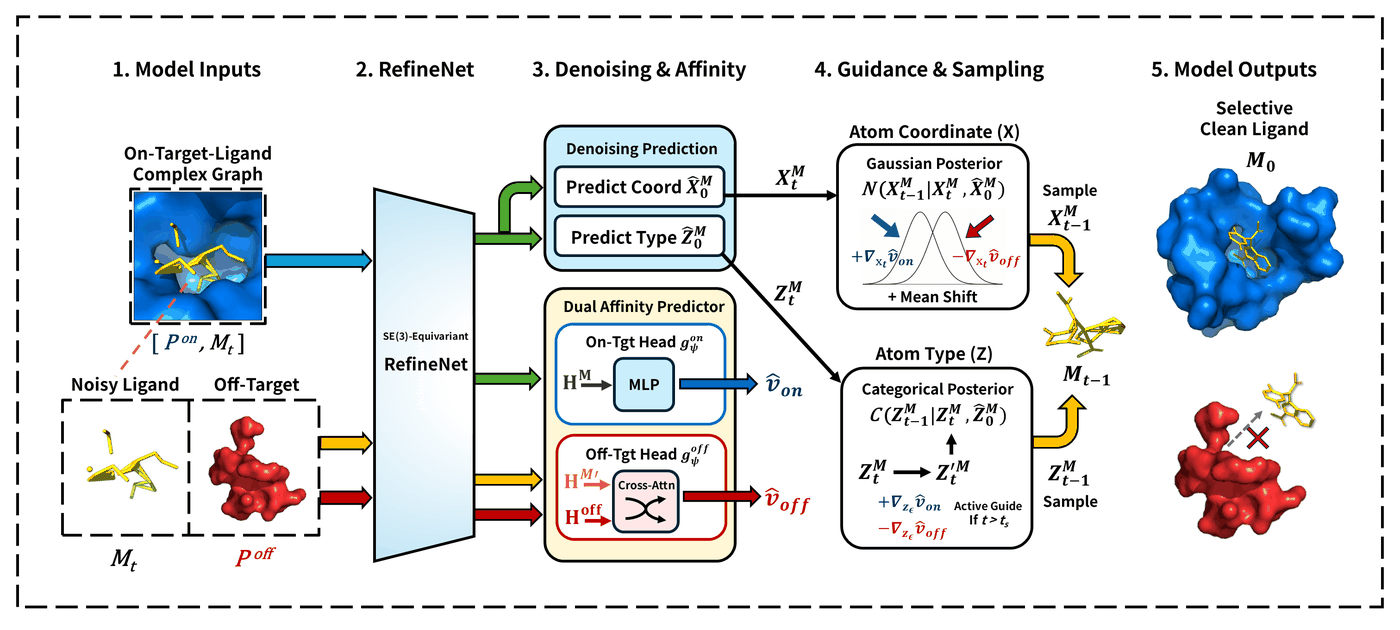
Making off-target avoidance an explicit generative objective. Dual-affinity guidance injects attractive on-target and repulsive off-target gradients into the denoising process, steering both atom types and coordinates toward a maximized affinity gap.
Diffusion Guidance Selectivity SBDD
Protein–Ligand Binding Affinity
Estimating affinity without a docked complex. Cross-attention over independently encoded protein and ligand embeddings bypasses 3D spatial alignment, making off-target affinity differentiable at every step of the reverse diffusion trajectory.
Cross-Attention Alignment-Free Docking Scores
3D Molecular Representation
SE(3)-equivariant architectures that keep molecular geometry consistent under rotation and translation, and diffusion formulations that generate atom types, bonds, and interatomic distances jointly rather than in sequence.
SE(3)-Equivariance EGNN Distance Matrix

Education

Current
2025.03 —
Integrated M.S./Ph.D. in Computer Science
Yonsei University, Sinchon Campus
Advisor: Prof. Sanghyun Park · AI-driven Drug Discovery
Graduate GPA: 4.15/4.3
Graduated
2019.03 — 2025.02
B.E. in Computer Engineering
Yonsei University, Mirae Campus
Double Major: Healthcare Convergence
Total GPA: 3.92/4.3 · Major GPA: 3.93/4.3

Publications
PAKDD 2026 1st Author Regular Paper Published
TheSelective: Dual Affinity-Guided Diffusion for Selective Molecular Generation
Hyoungjoon Park, Hwanhee Kim, Seungyeon Choi, Seungyong Lee, Yoonju Kim, Sanghyun Park
Pacific-Asia Conference on Knowledge Discovery and Data Mining (PAKDD), LNAI 16598, pp. 16–27, Springer, 2026
Overview of TheSelective: an on-target complex graph, a noisy ligand, and an off-target protein are encoded by an SE(3)-equivariant RefineNet; a dual affinity predictor produces on-target and off-target scores that guide atom coordinate and atom type sampling.
TheSelective encodes the on-target complex, the noisy ligand, and the off-target protein through a shared SE(3)-equivariant backbone, then guides reverse diffusion with an attractive on-target and a repulsive off-target affinity gradient.
Dual-affinity guided diffusion that maximizes the on-target/off-target binding gap without requiring off-target docked structures. Evaluated on CrossDocked2020 against TargetDiff, KGDiff, and BInD.
0.975Selectivity, TM-High
+15.5% vs. KGDiff
3.363Selectivity, TM-Low
+12.2% vs. KGDiff
−9.97On-target Vina, TM-High
best among all methods
−9.95On-target Vina, TM-Low
best among all methods
Full results — CrossDocked2020 (Avg. / Med.)
SetModelOn-Dock ↓Off-Dock ↑Selectivity ↑QED ↑SA ↑Success ↑
TM-HighTargetDiff−7.583 / −7.577−7.405 / −7.3910.178 / 0.1650.4690.58591.0%
BInD−7.510 / −7.569−7.391 / −7.4220.120 / 0.0620.5050.65888.1%
KGDiff−9.290 / −9.309−8.446 / −8.4660.844 / 0.7270.5270.54885.6%
TheSelective−9.969 / −9.958−8.994 / −9.0010.975 / 0.9230.4950.53450.2%
TM-LowTargetDiff−7.566 / −7.552−5.567 / −5.5641.999 / 1.9930.4670.58391.9%
BInD−7.536 / −7.589−5.608 / −5.6431.928 / 1.9340.5020.65489.1%
KGDiff−9.343 / −9.366−6.345 / −6.3932.998 / 2.9800.5280.54685.6%
TheSelective−9.954 / −9.909−6.591 / −6.5883.363 / 3.2590.5110.55756.9%
Selectivity = Off-Dock − On-Dock (kcal/mol); higher is better. QED / SA reported as Avg.
Success = fraction of molecules validly reconstructed by Open Babel and successfully docked against both proteins. The selectivity gain comes at a cost in reconstruction validity; recovering it is ongoing work.
KCC 2025 1st Author Published
Extended Diffusion Model for Molecular Graph Generation Incorporating Distance Matrix
Hyoungjoon Park, Seungyeon Choi, Hwanhee Kim, Seungyong Lee, Yoonju Kim, Sanghyun Park
Korea Computer Congress (KCC), Jeju, Korea, 2025
KCC 2024 Published
Comparison of Inference Acceleration Performance of CPU-based Image Classification Models
Ki Hoon Kwak, SangPil Cho, HoJun Shin, Hyoungjoon Park, GwangHyeon Yun, Young-Rae Cho
Korea Computer Congress (KCC), Jeju, Korea, 2024

Experience

Current
2025.03 —
Graduate Researcher
Yonsei University, Sinchon Campus
Research on AI-driven structure-based drug design. Developing diffusion-based frameworks for selective molecular generation, and protein–ligand interaction models for binding affinity prediction.
2024.06 — 2024.07
Short-Term International Research Intern
University of Nevada, Las Vegas (UNLV), USA
Completed a machine learning course and carried out a satellite land-cover image segmentation project.
2024.03 — 2024.06
Undergraduate Research Assistant
Applied Data Science LAB, Yonsei Univ. Mirae Campus
Presented paper reviews at lab seminars and assisted research on drug repositioning.

Projects

2025 — Present
TheSelective: Dual Affinity-Guided Diffusion for Selective Molecular Generation
Dual affinity-guided diffusion for selective 3D molecule generation. On-target attractive + off-target repulsive gradients with a scheduled guidance transition. Selectivity 0.975 (TM-High) / 3.363 (TM-Low) on CrossDocked2020, +15.5% / +12.2% over KGDiff. Published at PAKDD 2026.
Diffusion SBDD Selectivity PyTorch
2025.05 — 2025.11
LAIDD Mentoring Project: Small Molecule Generation & Target Activity Prediction
Small-molecule generation and activity prediction against target proteins. AI drug discovery mentoring program hosted by the Korea Pharmaceutical and Bio-Pharma Manufacturers Association (KPBMA).
LAIDD Mol Gen Activity Prediction KPBMA
2024 — 2025
3D Molecular Graph Generation with Distance Matrix
SDE-based diffusion that jointly generates atom types, bonds, and the 3D distance matrix, with Gaussian-kernel distance features integrated into the graph representation.
SDE GNN QM9 ZINC250k
2024.03 — 2024.06
Drug Repositioning with GCNs
Drug repositioning candidate discovery via GCN link prediction over a drug–disease heterogeneous network, evaluated with 10-fold cross-validation.
GCN Heterogeneous Net 10-Fold CV

Awards & Scholarships

2024
2nd Prize, AI-based Medical Data Analysis Competition
Intel Korea
2024
3rd Prize, Digital Healthcare Startup Idea Awards
Yonsei University
2019 · 2024
Academic Excellence Scholarship (×3)
Yonsei University
2024
SW Major Excellence Scholarship
Yonsei University
2020
1st Prize, Winter Java Training Camp
Yonsei University
2019
1st Prize, Summer C Language Training Camp
Yonsei University

Certifications

2025.11
LAIDD Mentoring Project — Small Molecule Generation & Target Activity Prediction
Korea Pharmaceutical and Bio-Pharma Manufacturers Association (KPBMA)
2024.09
TOEIC 860
ETS
2024.08
CDS Big Data Expert Training Camp with KNIME
Yonsei University
2024.02
Naver Cloud DB Computing Program
NAVER Cloud
2024.01
Healthcare Big Data Analysis with RStudio
Commento
2023.10
TOPCIT 425
IITP
2023.06
AI-based Medical Device Software Training
NIDS

Skills

Deep Learning
PyTorch PyTorch Geometric e3nn Diffusion Models SE(3)-Equivariant GNN Transformer
Drug Discovery
RDKit AutoDock Vina Open Babel CrossDocked2020 QED / SA TM-align
Languages
Python Java C SQL R LaTeX
Tools & Infra
Git Linux Docker W&B DDP Multi-GPU LMDB